
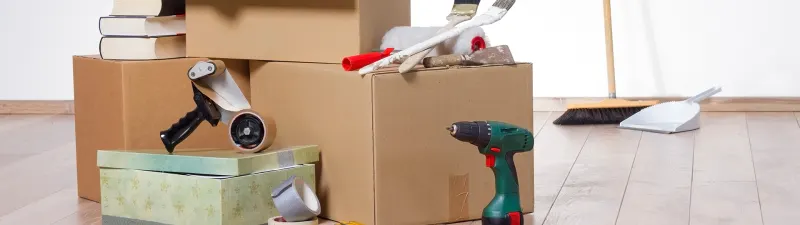
There are many good reasons to store furniture and other items in a self storage unit – read about a few of them on this page!
Unfortunately, life is finite, and a common reason for needing self storage arises when inheriting unexpectedly. Imagine you have an aunt whom you visit every few months; you get along well, she is older, and other family relationships are, shall we say, complicated. It happens. Your aunt unexpectedly passes away and names you as the main heir in her will. Suddenly, assuming you accept the inheritance, you are the owner of a 60s living room set, three wardrobes of ladies' clothing from the 70s, an older but lovingly maintained kitchen, and belongings filling around 40 moving boxes. On top of that, the lease for your aunt's flat ends in 10 days. What do you do?
For many heirs, this is a painful situation. On the one hand, you have to cope emotionally first. On the other hand, administrative hurdles are already burdensome enough – notifying authorities of a death is a huge task, organizing a funeral even more so, and then you are expected to go through her belongings and decide what memories of a loved one to keep and what to throw away. Many people cannot bring themselves to do that straight away. All the smells. The coat you huddled under as a child when it started raining on an outing? No, not yet. Understandably, many people don't have the emotional energy for that right away. So, due to the pressure to clear the flat, many inheritances temporarily end up in a self storage unit via a moving company until time and emotions allow you to deal with it.

A similar case occurs when someone dies without a will, which unfortunately happens very often even in culturally structure-oriented German-speaking societies. The administrator of the estate then has to take over the duties, often first having to find out if there is any family at all and, if so, who the next heir is. As a result, a 3th cousin and a first cousin who haven't seen each other for 20 years might suddenly meet again in a notary's office, learning about their uncle's death only then. Until that point, the administrator must take care of the assets. From then on, the heirs have to look after them. In this scenario, all three suddenly have an unplanned need for self storage.
Or you simply do not want to give away this collection of mementos. You want to keep them and know they are there. As if a beloved pet, a cherished aunt, or an endlessly kind grandmother were not lost forever, but had simply moved away, and you can visit a place where you can at least see their things to remember them whenever you wish.
Particularly in major cities with historic buildings, space is often at a premium, even if you have a cellar. You may have seen something like this before: after climbing down 40 old, wobbly, dimly lit steps and finally finding the key in a dark corridor among rat droppings, poison traps, cobwebs, and caterpillars, you open the creaking door, risk your health to press the light switch for the 40-year-old 20 Watt bulb... and find yourself facing a mold habitat that should probably be a protected nature reserve.

Decades of undisturbed growth, darkness and constant humidity have led to metre-long carpets of mould that almost have a certain beauty in their grossness. Cleaning, drying out, plastering and properly restoring access to these cellars is often "not in the budget" for property owners. In most cases, it doesn't pay off either, because you can't keep the moisture out at all – it keeps coming back. And then there is the security issue: you cannot properly secure the 100-year-old wooden door. In major cities in particular, there are cellars that often serve as a place to sleep for people who have nowhere else to go, via access points known only to insiders. And no matter how sad that is: when you store your things somewhere, you don't want anyone else going through them at their leisure to see if there is anything valuable. That is why the solution for extra space, when the cellar is unsuitable, is often a self storage unit nearby.
Historic buildings with pre-war pipework, brittle lead or cheap plastic pipes installed in the 70s, broken washing machines on the 4rd floor of an old building, water connections without pressure relief valves, freezing water in the pipes... the list of potential causes is long. One day you come home, and if you are lucky in your misfortune, you still have time to get a removal company to fetch your items and store them temporarily in a self storage unit. If you are unlucky, your collection of favorite old CDs comes floating towards you, destroyed forever. Water damage is another reason why people unexpectedly need to rent a storage unit—after all, what is the alternative? Leave everything in the water and see what happens?

Is love not wonderful? Two people meet, get to know each other, want to spend more and more time together, and eventually the idea of moving in together comes up. It has its advantages: you only pay electricity, utilities, and rent once, you share the housework (hopefully), and you only have to cook half as often. However, the new flat is often not as large as the combined area of the two previous flats; you effectively downsize, making it a physical impossibility to fit ALL the furniture and ALL the belongings of both parties into the new home.

So you sort through everything carefully, and furniture you do not currently need, along with items used only occasionally, are moved to a self storage unit in one go. Rumor has it that the vast majority of belongings stored this way belong to the male partner, who (almost exclusively) has to move his items into a storage unit—though these remain unconfirmed reports.
A self storage provider who wishes to remain anonymous once told us about a customer: he was single and went abroad for his company for 2 years. During that time, he self-stored his belongings with the provider. When he returned from abroad, he was married, and the young couple found a flat and furnished it completely anew. By his account, they were very happy. Whether the wife knows about it is unknown, and if she does not and finds out, she might be quite unimpressed, but the customer still keeps his stored single-household items—just in case. If the marriage does not last, he can fully furnish a small flat within hours. You could say he has a backup plan.
Unfortunately, relationships also end. Sometimes not so unfortunately—not every lid fits every pot. In any case, once cracks appear in the relationship, you usually no longer want to share a living space, so at least one partner has to move out. However, the short-term budget for new rent, available space in the new flat, an emotionally manageable timeframe, and the volume of belongings in m3 do not always align perfectly, bringing you right back to needing more storage space than you have. Self storage is ideal in such cases too: you can store belongings flexibly at short notice and retrieve them gradually or all at once when you find a better, long-term home.

Then there are couples who are, well, a bit unique. Those who have not yet found the right balance between closeness and distance. Such couples often break up with great fanfare and drama across social networks, online and offline, only to realize they miss being able to tell each other every hour how much they hate one another. The distance increases their relational gravity—they attract each other like two black holes, collide again, and so on.

Self storage is also perfectly suited for this lifestyle, which is often observed in big cities: the person moving out can wait 2–3 weeks to see if the bond between them was just stretched rather than broken, without entering into a new lease or making a major investment, provided a friend lets them crash on their sofa for a few weeks.
Our world is shrinking – at least from a data point of view. The economy is becoming ever more interconnected: if a glass of beer is drained in Bavaria, a Japanese man gets a headache the next day. And this global economy needs expertise in specific places, and cannot or will not wait for a local to be found with the exact same qualifications as someone from elsewhere. Whether it's an experienced electrician travelling on assembly work from Vienna to Hamburg, a bottling plant specialist called from Lausanne to Munich – although that example might make more sense the other way round – or an SAP programmer dispatched from Karlsruhe to Zurich, the questions are always the same: How long will I be here? Does it make sense to take a large, expensive flat? Will I even like it here? If the company thrives at the new location, will they need me longer? And on top of that, rental prices naturally differ massively: for the money an East German waiter could afford in Leipzig, he gets a post office box at best in St. Moritz, while a country boy from Austria inquires about social security benefits first thing upon seeing rent prices in Frankfurt.

These highly specialised professionals from elsewhere who move abroad for an indefinite period are called expats. And the more international the city, the more of them there are. In these cases too, it often makes sense to rent a storage unit both at home and at the destination – to see how things develop first and settle in gradually.
Marco Polo. Columbus. Sir Francis Drake. The scent of unfamiliar spices. The thrill of exploring the unknown. Seeing new colours, walking new paths, experiencing new tastes and discovering new cultures – often even of the bacterial kind. Few things expand your horizons as much as a stay abroad: you gain a newfound respect for other cultures, learn about your own strengths and weaknesses, and discover what you actually want from life. Many people, especially young adults – but in recent years also more and more young families – are following this trend and heading abroad for 6 or 12 months.

Yet they still need somewhere to store their belongings, even if they sublet their flat, for example. Here, a storage unit is the ideal solution to keep items clean, dry and, above all, safe from temporary tenants. Once the stay abroad is over, you can return to your own home.
In the interest of personal, mental clarity, many clever guidebooks advise clearing out your belongings every few months. Clothes you no longer wear, books you no longer read, DVD and CD collections you haven't listened to in ages, the guitar you haven't touched for years – everything needs to go. But what if you DON'T want to part with things completely just yet? What if a temporary separation makes sense? What if the next Eric Clapton suffers a crisis of purpose right before his big breakthrough, and only starts playing again 6 months later?
Self storage is ideal so that the world isn't deprived of talent, and so you don't always have to rip off the emotional plaster all at once. You can test what it feels like to live without a surfboard in the kitchen, without throwing away the only 2,5-metre-long piece of dusty fibreglass proving that Dad was once a wild one.
Every young family's dream... a home of their own. Ideally a new build, a blank canvas where you can help design everything yourself! Choosing the colours yourself! Defining the floor plan yourself! The large windows! How much do those cost? The normal windows! Many couples and families take the step from renting to buying property and commit to fixed dates. On THIS date they have to leave their old flat. On THIS date the terraced house will be ready. Honestly! Promise! Has any construction company ever failed to finish on time?

Well, as it turns out, the vast majority. In these cases, you get everything from partially habitable, to mostly habitable but still without heating and tradespeople in the house daily from 6:00 to 15:00, to "We're staying with Grandma for 2 weeks". Here again, a storage unit is the ideal buffer storage for all the furniture and personal belongings that don't have a place yet.
Unfortunately, there are also cases where people living in a happy relationship, with no family bereavements, who don't need to go abroad and are actually quite content, are forced to move out. Be it due to a fire that didn't affect their own 4 walls, but compromised the structural integrity of the building. Be it due to ruthless property speculators driving tenants out of older flats, or rent increases so steep that you simply can't keep up and have to move out. In these situations, when temporary extra space is required, a storage unit serves as a convenient safety net to store furniture temporarily.
A self storage operator once told us about a customer, a young man in his early 20s. He had just moved into his first flat, secured an apprenticeship, saved up a bit of cash, and invited his friends over for drinks that evening. There was no sofa in the living room yet, so he went to the furniture store at 9 to find one. He finds one, fits perfectly, delivery service is completely free and available immediately. Turns out a delivery service isn't a removal company; they only deliver to the kerbside, not to the 4rd floor of an old building.

To get the -75% genuine leather single piece upstairs, he needed a furniture lift, which unfortunately only comes with a technician who doesn't just wait around for calls. So the young man had to have the sofa transported to a storage unit for more money than it cost. But it gets better: when a crew with a furniture lift was available 2 weeks later and hoisted the monster through the window into the flat, the sofa was so wide that the only way to set it up completely blocked the door. The young man, staying consistent at least, had the sofa taken back to the storage unit and looked for a new flat.
You are moving from one flat to another, but for some reason you cannot use the whole flat just yet: the owner wants to use one room as storage for another month because they have run out of space, a room still needs painting, the bathroom is being re-tiled, or the parquet in the living room hasn't been sanded down yet because the specialist fell ill at short notice. In these cases, self storage offers a temporary buffer where you can store excess furniture.

Especially where the level of discomfort is high, the desire for a nicer home grows rapidly. In big cities, there are unfortunately more noisy neighbours—simply because there are more neighbours and people live closer together. At 21, you are thrilled to have found a cheap flat right in the nightlife district; by 30, you are already planning weekend trips to avoid street festivals; by 35, you can no longer take it and your patience has completely run out. Noise causes stress, and too much stress reduces your concentration, sleep quality, ability to work, and ultimately your life expectancy.
So it is no surprise that a significant proportion of furniture storage happens because someone is moving due to noise, or simply wants a nicer place to live. After years in a concrete jungle looking straight into the opposite living room, you finally get a bit more light, higher up, or even in an attic flat. After years next to a student hall, you finally get a small garden with just 3 adjacent neighbour where there used to be 400.
Often, the new layout, available space, and required space do not match here either, and you want to rent a cheap storage unit as an interim solution. Self storage provides a solution for this too.

Particularly those who come from the countryside themselves and have a larger family know the phenomenon: once someone has taken the step into the big city and hasn't been swallowed up by it, but seems to be doing quite well, other family members suddenly announce their arrival. They unexpectedly want to go to university too, do further training, or look for a job. Often to the annoyance of their hosts, the sofa is suddenly blocked for weeks, and you get to know your relatives up close and personal through the shared bathroom, fridge, and other live habits in ways you never actually wanted.
Many of these late arrivals first store a large part of their belongings in a self storage unit before finding a suitable flat—especially if the decision to go to college was spontaneous, school starts in a few days, and the housing market turns out to be tougher than expected.

Another kind of addition can also create a space issue where there was none before. The small home office is suddenly a nursery, the ambitiously equipped "home gym" is now in the hallway—it is surprising how such a small person can need so much space so quickly. The furniture that has to make way temporarily, but of course also the fitness equipment whose transport often represents its first contact with sweat, are in safe hands in a self storage unit.
A lovely reason for a temporary need for space is the renovation of your own 4 walls. If the cellar isn't enough, your living room furniture, sofa, chest of drawers, etc. simply have to go into a rented self storage unit until the walls shine in new paint, the new floor is professionally laid, or a partition wall is put up.

Another popular occasion for acute storage needs is holidays. It has been known to happen that you come home with more luggage than you left with. On the other hand, there are also seasonal items that you simply don't need all year round. Skis used for one week a year. The surfboard, bodyboard, kiteboard, kite, sail, snowboard, snowboard or ski boots, winter sports clothes, summer sports cloth—well, maybe not so much the latter. But you want to know all these items are safe until you need them again, and renting a self storage unit is ideal for this.

A final and extremely sad occasion for an acute need for space is natural disasters. Flooding has made its way into the cellar or living room. A storm has sent a roof tile—or worse, a tree—against a window, lightning has disabled the entire building services, or leaking roofs let water in after days of severe weather. Fortunately, in these cases you can quickly and easily move things to a self storage unit and save your valuable personal belongings from damage.
Looking for storage space?
All locations with live availability and prices – book online in minutes.
More good to know
What is self storage?
What is self storage? We explain the concept of renting storage space: secure units from 1–40 m³, flexible …
How does self storage work?
How does self storage work? Renting your storage unit is that easy: book online, move in with a PIN code, …
Rent a PO box
Rent a PO box in Switzerland: Get your personal PO box at Squarefoot with a flexible rental period …